Category: strategy

  • What Price Independence? Music Walks the Wall…

    Last year (2024) was an interesting year for independent music companies, and also for attempts to institutionalise independence in music. Most of us can walk along a low wall with no problem, but given the same surface and a few metres drop to the sides we freeze or panic. It seems to me that independent music is now, in 2025, walking the wall. Satire often resides in the nuance rather than the subject of a scene, and the story of independence in music really is the nuance. So, with full awareness of the risk of committing the fallacy of an irrelevant conclusion – ignoratio elenchi – I am going to pick out a few of the more fun things that happened during the year recently passed, and pretend that my collage has form, and relevance for the present and future of independent music.

    Fiercely Independent…

    In February 2024, Bella Union, an independent record label with deeply creative origins, declared a new dependence on Believe, a venture capital funded music distributor which a few years ago had listed on the Euronext stock exchange. The label’s justification was that its new feeding tube was ‘fiercely independent’.

    “A modern, vibrant company with an incredible story and phenomenal growth, Believe are the queens of the digital age. Fiercely independent like us, we feel loved, and we will give it back in spades” said Bella Union’s founder. Capital markets had been taking a different view: ‘fiercely independent’ Believe’s [BLV] not so queenly share price had been below the IPO price for a long time, and its founder was trying to persuade some other financiers to buy the company.

    The very next month, March 2024, saw the start of a melodrama that could have realigned a large chunk of the Euro/American music industry, as Warner announced it was making a bid to buy Believe, this self-appointed flag bearer of independence in music. Warner’s bid fizzled out, and some extraordinary backstairs financial shenanigans saw Believe’s founder eventually finagle the business out of its public listing and into some private equity portfolios. A company might say it is ‘independent AF’, but when its shares are held by the very same sort of entities as own chunks of the biggest music companies (one shareholder, TCV, also holds stakes in Bytedance, Facebook, and Spotify) we are entitled to ask, ‘independent from what?’

    Independence 3 Ways

    The music industry has always had a confused and difficult relationship with independence. It is at the same time a genre of music, an economic classification of owners of sound recordings, and an attitude (presumably only needing to be applied to those who have lost their economic independence). None of these attributions are really strong enough to stand up to scrutiny, but let’s anyway take them in reverse order, and see what if anything is wriggling on the microscope slide.

    As an attitude ‘independence’ has been one of the social functions of music for many years. Wherever the boundaries lie, in politics, societal norms, identity, there you will find music articulating the alienation or defiance many people feel. For most of us, barring a handful of genuine iconoclasts, an independent attitude expressed through music is no more than a very safe kind of confrontation with the conservatism of daily life. Barring a few crusties, the vast Glastonbury crowds are back working or studying on Monday morning.

    As a genre ‘indie’ falls in different places for each of us, making it almost a self-reflexive Rorschach test. I have an image in my mind of a delta; the multi-furcated flow of a river through channels deep and shallow, broad and narrow, pools, swamp, and brackish lagoons before the flows and seeps reach the great ocean of pop assimilation. Music consumed perhaps with a frown, or a gurn, rather than the bland smile of a less strenuous pastime. It’s hard to think of a single style of music that has escaped the dignity of an ‘indie’ variant. Indie disco? You got it!!

    So how does independence fare in an analysis of the economics of music production and distribution? Some of the best comedy is delivered deadpan, the protagonist seemingly completely unaware of the exponential absurdity of the lines they are delivering. In the ‘quotes’ bit of the press release that announced UMG’s obfuscated acquisition of PIAS, one of Europe’s most embedded and systemically important independent music companies, Sir Lucien Grainge, UMG chairman and CEO, was given these words, worth quoting at length:

    At UMG, we understand that a vibrant independent sector is essential to a thriving music ecosystem. After all, we are a company built by – and for – entrepreneurs and today serve as an accelerator for so many independent creative voices, which is why we are delighted to provide PIAS the support and resources to bolster their company as a fiercely independent force in music. [Note that formulaic ‘fiercely independent’ again – never placid, those indies, even when selling out to the majors.]

    Obfuscation by Gaslight

    It is for good reason that I call it this an obfuscated acquisition. Independent music trade associations contorted themselves to maintain the facade that PIAS had not been bought. One association head told me that UMG owning outright 49% of PIAS and holding a charge on all the assets as security for what was no doubt a convertible or un-repayable loan was ‘a JV like any other’. The incoming CEO of another trade association provided some additional context:

    Q: So you can be considered an independent artist if you’re distributed by a major? “Absolutely. The proliferation of self-releasing artists who are their own label and create their own team has really exploded in the last five years. The importance is really the nature of the deal and the control that artists have over their output, ownership and creative vision. [Just] because you are going through the Warner Music or Universal Music systems, it doesn’t mean that you’re not necessarily independent anymore.”

    In some ways this is an admirably inclusive position to take, for it is surely possible to become self-defeatingly reductive about independence, to the point where any interaction with the bigger and more globalised end of the music industry becomes an act of betrayal. But on the other hand, an indie trade association should be prepared to call bullshit on a position that calls its essential purpose into question.

    The Dog That Did Not Bark

    If trade associations see nothing to defend in structural independence, what’s left for the businesses and the music represented by them? In another obfuscated acquisition the laughably named Utopia Distribution Services was saved from insolvency by loans from Universal and Sony, to widespread relief. It had managed to create almost a monopolistic position in distribution of vinyl and CDs for independent record labels; that dependency presumably put its continuation at the whim of the business affairs departments at two major record companies. The distributed labels could only hope noblesse obliged, as another pillar of structural independence was knocked away.

    The tail end of 2024 saw the announcement that the other 51% of PIAS would be changing hands, shortly after some of its distribution clients announced they would move their business to a new distribution entity with a mysteriously nebulous corporate existence. Perhaps, rather than heralding a new approach to shipping vinyl, this says something about the terms of Universal’s call option on those PIAS shares. The new entity seems to be operated by the same business that rescued Utopia, having previously been bought by it; Sherlock Holmes might say this was a case of the dog that did not bark.

    Commoditised Independence

    It would be fair to ask what iconoclasts and the structuralists really contribute; or whether independence is after all a commodity that can be produced by the normal application of capital in markets.

    First, some sage advice to new record label founders from someone many revere as an icon of independence, Martin Mills: “Don’t do it for the money.” (cited from here). This might indeed be realistic, but surely a record label needs to show some existential awareness of the value it (hopefully) creates. Indeed, it’s arguable that a record label’s core job is to ‘do it for the money’. The artists and audiences can take care of much of the rest. But perhaps the sentiment was more a kind of commercial predestinarianism, where obvious wealth is taken as a sign of virtue rather than of nous and graft.

    Whatever the intent, the outcome of a community of businesses unmotivated by money is likely to be underdeveloped product, and artist careers blighted by lack of investment. I say likely – it is possible that a benevolent government or philanthropist puts a few tenners in the hat, or tips the scales to lubricate the independent music industry as an engine of public goods. But even then markets and capital are likely to win. And Mills’s own company is a case study in capitalistic success on a small scale. A real beacon for ‘doing it for the money’ in the creative industries!

    United We Fall

    The tip of the tail end of 2024 delivered another update, this time from a company that claims to be “focused on powering independence across the music industry.” That company would be Downtown, which spent a few years buying smaller independent service providers having jettisoned a catalogue of music rights and given up being a publisher. And in December announced that it had agreed to be bought by PIAS acquirer Universal in the guise of Virgin Music Label & Artist Services, named after a once iconoclastic and independent music company acquired by EMI. Downtown’s own independence is not easy to locate; the part most significant to independent labels and artists seems to be owned by offshore trusts. Perhaps it will all come to light in a competition enquiry, which will surely want to know why the complainers have so little foresight that they chose to become dependent on a business whose existential need was to get bought by the biggest fish in the pond. 

    Circle the Wagons!

    All this makes 2025 seem like a year if ever there was one to circle the wagons. A small record label always has been a tiny node in a web of relationships without which it could not operate. But the digital music market is mostly owned and run by the biggest companies on the planet, and the same huge companies mediate the audience relationship. Even the old physical world of gigs and vinyl is utterly tech dependent.

    In such an environment the instincts that worked in the past might be counter-productive. Herding small labels into collective deals and onto VC funded platforms looks more like salmon farming than habitat and ecosystem conservation. In other words, the kind of mutually defensive collective action that independent companies instinctively embraced in the digital world has not secured independence. Instead it seems to have produced a giant conveyor belt of independent music copyrights and capabilities into the infinitely hungry consolidators and asset managers of the new music industry.

    Yet independent labels are and will remain totally dependent on investment in the technology and services they need to connect to markets. Blighting the investment environment for this essential layer will precipitate a rapid cascade of consolidation that labels would be powerless to stop.

    Independence in Q2, C21…

    It’s intriguing that in 2024 Believe, a company founded by venture capital, owned part by private equity and part through a public listing, with a market capitalisation of €1.5b, could be thought ‘fiercely independent’. Reason says no, it is subservient to the logic and needs of the managers of capital. So this kind of independence must be a different kind. Not structural, more confectionary, perhaps. That’s a very different kind of commodity than that which could be produced by an independent capitalist like Martin Mills.

    Because really that has to be what independence is about – a choice over one’s relationship to capital and the ownership of the mechanisms of value creation. Those mechanisms might be no longer artisanal but prove daily to be as efficient at a smaller and more personal scale as when operated by the committees whose care primarily is for extreme wealth. If independent labels were not such engines of value there would be little to no incentive for the consolidators, or ‘factory ships’ as we might call them, to package them up and sell them.

    It remains to be seen if the competition authorities in the UK and EU are going to take the wailing and hand wringing seriously. Their first question might well be, ‘if you value independence so much, why did you not choose more securely independent routes to market, or negotiate change of control clauses in your contracts?’ They might also wonder whether spoiling the value of investment in critical technology and services is a smart response, when a pathological reluctance to pay a reasonable price for the risk taken and the talent deployed means that the only path to value for investors is to aggregate, lock in, and sell.

  • A Pigouvian Pollution Tax on ChatGPT!

    If one had to characterise the state of mind among knowledge and creative workers, musicians included, in 2022, worries about meeting demand for quantity or variety of content would not figure high. Misinformation, provenance, and the difficulties of making a living, yes. Being short a few million blog posts, product reviews, or new music tracks, no.

    So it was perhaps a bit surprising when the appearance of a flock of AI engines, and their ubermensch ChatGPT, an easy to use interface to a new text AI, generated (pun intended) wild enthusiasm, along with some doomsterism, and of course digital reams of new content as the commentariat contemplated their own industry’s potential demise. Perhaps the boosters thought that with AI doing the creative stuff they would have more time for the real work; self-promotion.

    There were some practical responses too. Stack Overflow, the techie Q&A site, moved quickly last month to ban answers generated by pasting questions into ChatGPT. Their reasoning? “…while the answers which ChatGPT produces have a high rate of being incorrect, they typically look like they might be good and the answers are very easy to produce”. New York City schools followed with another swift ban, adding concern for safety and appropriateness.

    Behind ChatGPT is a language model developed by OpenAI. It can output school essays, reviews on Amazon, answers on Stack Overflow, even rather lame sonnets (try it!). Other AI models produce images, music, and video, churning out in seconds what would take humans hours or days.

    AI output is being widely monetised in copyright markets intended to nurture human understanding, research skills, and creativity, over which it has unfair cost and quantity advantages. Here’s California’s Boomy Corporation, an AI music generator, boasting about its productivity: “Boomy users have created 10,900,994 songs, around 10.8% of the world’s recorded music.” Of course the bit about Boomy users creating songs is a lie – the users filled in a short form and tapped some buttons.

    Anything that can be consumed as news, opinion, entertainment, or art, can be over-produced by these generative AI systems, making them part of what I term ‘hypercompetition’. This is a seemingly ineluctable rule of the classical platform business model, which bundles distribution with curation, and follows up with interventions to increase supply. The aim is to heighten competition with and between human practitioners in the monthly zero sum subscription share-out games.

    AI could make light of much drudgework and formal, logical writing, freeing time for more human creativity. It will almost certainly accelerate knowledge extraction and cataloguing in some specialist fields. But almost all ChatGPT output is spam, low quality stuff we really don’t need more of. However I’d argue we should not push string by trying to ban AI. Instead we should treat it like the pollution it is, and slap a large Pigouvian tax on it. 

    Some activities create costs that are borne by people who don’t share in the gains of those undertaking them. Congested roads, smoke from factory chimneys, and unusual demands on publicly funded health services are examples. Economists think of these as costs external to the economic activity associated with producing things, driving somewhere, or smoking tobacco. There are rare cases of external gains too; think of how good state-funded schools inflate property prices in their catchment areas.

    The external costs from ChatGPT are the teachers’ time and effort, and pupils’ lack of learning caused by cheating at school, incorrect Stack Overflow advice followed, as well as revenue extracted from copyright markets and the extra efforts human creators need to put in to compete. Arthur Pigou himself, Cambridge Professor of Economics in the first half of the C20th, was deeply interested in welfare. He argued that tax was the simplest and most effective way to deal with gains and losses that fell to those outside of a transaction.

    As well as being a redress for harmful activity, Pigouvian taxes can provide funding for more of what we do want. This is important – interventions need to have broad popular understanding and support. In this case the harms fall on education and the arts, two  significant absorbers of taxpayers money which could be supplemented or offset.

    I asked ChatGPT if it thought it should be taxed; it denied any knowledge of itself. It might not yet write a decent poem, but AI has clearly got its head around tax evasion.

  • Fair Shares, Fair Markets. Can Music Have Both?

    The music we listen to on music services has many creators, facilitators, and distributors. Everyone wants to be paid fairly for their work, and get a fair share of any future revenue. But are any of the different types of contributors – artists, songwriters, etc., – treated so unfairly, or do any of them so systematically disadvantage other groups, that we need systemic change?

    The way music and recordings get made and experienced might seem complex to an outsider or a neophyte. In simple terms, composers and songwriters write the music, artists perform it, and if anyone records the performance the person or company who organised it is deemed by law to own the copyright in the recording. Copyright laws make it possible for composers and performers to form contracts with investors, and with people who can turn the music and recordings into revenue. So, for instance, what is commonly called a record deal is an exclusive right to record future performances – the right to make records.

    In music’s case this moderate degree of complexity delivers the great benefit of flexibility which allows the same contractual and back end processes to accommodate a very wide range of musical practices with only moderate stresses and strains. Someone who produces electronic dance music entirely in software and at their own behest and risk ends up with copyrights and remuneration rights that they can chance in the market if they wish, and no obligations to anyone else. At the other end of the scale, anyone with the money can commission new compositions, agree terms with a group of musicians, and hire a producer to make recordings.

    People at the creative end of the music industry have traditionally made a calculated trade off, between money now, and money in the future if the music should prove successful in the market. If their need for money now is greater, to support a bigger team and a better recording studio or to bring in the services of songwriters with a track record of hits, they can seek investors, who, given the specialist nature of the music industry, are likely to have a track record themselves.

    Some of the public arguments over fair pay and fair markets that surface in the music industry seem either wilfully ignorant or cynical. As always it helps to know who has work and investment at risk, and who has already been paid. Some terms used are unhelpful – ‘artist’ for instance, which often conflates the role of composer, performer, and producer of the sound recording. The basis on which each person’s work is contributed is often obfuscated. An instrumental performer should have been paid for work done, while a record company might have made an un-repayable but recoupable advance to members of a band for a recording. Some parties end up with copyrights, some with remuneration rights, and some with a pay cheque.

    The music industry – notoriously – doesn’t have a perfect record in attributing work correctly and fairly, and has been know to take advantage of the ignorance of musicians about copyright and contracts. Neither law nor standard industry practice protects this kind of behaviour, and when it surfaces there is justified public outrage. When anyone with an interest says ‘fair’ they invariably mean more; no interest group would get support if they argued for less. Music is no exception. Lobbyists, trade associations, grassroots organisation, unions, politicians; all are engaged in a constant round of appeals to public and regulators to change the terms on which they trade.

    A growing market delivers more to most participants of course. And a changing market often re-orders the way it rewards the different contributors. But it is hard to argue that anyone is deterred from entering this complex market, or that the cost of doing so is prohibitively high in all but the least developed economies. So perhaps, while always being alert to the signs of exploitation and foreclosure, we should have a little more trust in the market to decide what is fair.

  • Hypercompetition. How Platforms Destroy Markets.

    The first rule of platform business success: increase supply as far beyond the market’s ability to sustain the suppliers as possible. It doesn’t really matter how – and many tactics have been tried. It doesn’t matter what it costs either – the prize is worth it. And it seems structural, by which I mean that this is an imperative for platforms if they are to succeed, imposed on them by their mode of business rather than an option they can choose or reject.

    It’s easy to look across many fields of endeavour and see this processes happening. There are more taxi drivers per customer than ever; more restaurants delivering for each eater; more brands and more retailers for each product, and for each buyer of a product; more writers for every reader of the news, etc.

    This idea, I call ‘hypercompetion’.

    Hypercompetition is far from a worked up and formal concept; it started as some observations that seemed to me to be connected to each other or related somehow, and has been forming gradually into a model. It’s an attempt to make sense of how some areas of our platform-mediated lives are evolving.

    In music, streaming services have had a few years of fast growth in subscriber numbers and revenue, but faster growth in the number of artists active in the market. Music’s hypercompetition looks something like this:

    Digital tools have made it quicker and cheaper to produce and distribute new tracks. Hobbyist and semi-professional music producers have moved to an assumption of distribution, rather than an assumption that they will negotiate with an intermediary. With a bigger market of music producers who have less of a focus on a return on their investment, more digital tools arrive making it even quicker and even cheaper to produce and distribute. Some producers have visible success without engaging with an old intermediary.

    This phase in the process could be called a competitive acceleration perhaps, and as it took its course observers tended to describe music making as ‘democratised’, although many areas of the music market were already very democratic. Perversely the new mode seems to create more opportunities for those with private incomes and a capital cushion to fund their projects.

    Whatever you call it, previous market barriers have been broken. And it could be argued this is good for creators and intermediaries – the intermediaries that used to do very little for their rents will struggle, and others will work harder to prove their worth. Creators too find themselves working harder, making and releasing more music, and logging in daily to social media and dashboards.

    The next phase moves beyond normal competition. This is what I have started calling ‘hyercompetition’. One or more interventions bring about an influx of new participants in music production and distribution. These have included include software that effectively makes music for you; marketplaces for services that help put together releases; and quick, cheap, ’no questions asked’ distribution services. It’s very hard to say that the innovations and interventions are meeting a latent demand – they seem to create demand that would not otherwise have existed.

    Hridayeshwar Singh Bhati, with his 6 and more dimensional chess variants.

    At this point one can see a few characteristic signs that the nature of competition has changed in three important ways.

    First it is no longer reasonable for creators to expect any meaningful payment, or more than a token audience beyond their friendship circle. Second, intermediaries know that they need to charge for what they do, as there is no longer a reasonable expectation that revenue from their successes will pay for the failures. Third, withholding the music becomes meaningless to the consumer music services, so producers and intermediaries lose any value in exclusivity, or any negotiating or pricing power when selling to consumer services.

    When withholding is meaningless, and when no reward can reasonably be expected for the inventory (rather than the services around its production and distribution), that seems to me to indicate the destruction of the market for recorded music.

    With the recorded music market effectively dead it’s likely that consumer music services will increasingly see their ’suppliers’ – music producers and intermediaries – as customers. They are in a position to define entirely new categories of goods and services simply by changing the rules of visibility and success. They need to be careful; there are plenty of examples where consumer services, two sided markets, and platforms, have replaced high quality goods and sophisticated supply chains with aggregations of undifferentiated low quality goods.

    There is of course a big impact on service providers to the markets that are being disrupted, whose customers previously were a smaller number of professional producers and intermediaries. As consumer services and intermediaries are selling services to producers, the old service providers end up with a massive increase in the number of potential customers; but challenged, on price and service and in the sophistication and competence of their customers. It is almost as though hypercompetion is recursively imported into each community it touches.

    So here’s an attempt to summarise a few characteristics of hypercompetition:

    1. Unreasonably high contention for success – not just 1:10, or 1:20 as in the old music industry. Now more like 1:100,000.
    2. Close to cost-free and barrier-free entry to the market for a new participant; certainly no qualification or quality requirement.
    3. Inversion of supplier/customer categories – suppliers become customers.
    4. Intermediaries become service providers rather than sharing revenue/success.
    5. Service providers import competition from their previous customers, the intermediaries and producers.

    This is a small window into a very big and complex idea. I called it hypercompetition to capture the sense of a competition which is all against all, and in which what you win is simply the right to continue to compete.

    Importantly, platforms seem to succeed to the extent they can generate hypercompetition. If you are a supplier, platforms are effectively casinos. In music you often see service providers advertising ‘keep 100% of your copyright’. It’s not valuable; it has become a lottery ticket.

    What comes next after this kind of mass meltdown?

    I have been interested in chess for a long time – not as a player, but as an observer. Cheap computers have been beating the best players for decades. It’s just as difficult to play as it ever was. There’s a small but lively market for learning aids of all kinds. Chess as a spectator sport continues to develop, and has generated the biggest aggregate prize fund of all e-sports due to the pandemic migration online. My guess is we like watching humans attempt very difficult things, so my long term bet on music is that it becomes more focused around human activity, and the value in the created audio object drains away over time.

  • Platformed! Music’s New ‘Disempowerment’ Business Model

    In his book, Noise, Jacques Attali makes a startling assertion – that music is the vanguard of revolution. Changes, he says, in the relationship between music and the economic and social structures that govern its position and remuneration prefigure fundamental changes in those structures themselves.

    He’s probably too busy to publish an update, but with file sharing, unbundling, streaming, and UGC, the quarter century since the last edition has been a carousel of economic and social beasts for music to try to ride. In the music industry itself it became a truism that what happens first to music happens next to other industries. Now, in 2021, it’s worth asking, at whose volition do such revolutions arrive? And is it possible to make a collective choice, based on some ideas of rights and values, rather than concede to the brute force of wealth and power?

    Attali’s Noise is a complex and dense work. I’d been struggling through it with the effort of an untrained reader, dealing as well as I could with its formal language and concepts, when the UK’s Supreme Court handed down a judgement in favour of Uber drivers. The drivers had challenged Uber’s view that each of them was an entrepreneur, a sole trader, a business, and that they therefore had none of the rights and protections of employees.

    Uber itself had been founded by someone known to the music industry, Travis Kalanick, whose ‘Scour’ peer to peer filesharing application was part of that music industry carousel. Fairwork, a project based at Oxford University’s Internet Institute, tells the story with  Yaseem Aslam, one of the drivers.

    You can find the podcast here: https://shows.acast.com/fairwork-podcast/episodes/003-contracts

    https://play.acast.com/s/3173f311-cf17-5fa4-a6ee-ebf36adabc6e/603e41fb89244d1f6098bdc2

    What comes across strongly as Yaseem speaks is his sense of entrapment. What seemed at first like a liberation from the constraints and sometimes unfairness of an industry based on human decisions turns, ride by ride, into a world of harm and unaccountability, an active rejection by Uber of responsibility towards the drivers.

    It’s possible to see this simply as regulatory arbitrage, and an application of Clay Christiansen’s ‘disruptive innovation’, with Uber unlocking assets that had previously been under-utilised – the drivers’ cars and in many cases the time they would have spent with families or sleeping. But, listening, I couldn’t help thinking of Uber’s share price, and it seemed to me that Uber had managed to convert not just the surplus from their labour, but also the safety, freedom, self respect, and the human rights of the drivers, into wealth for its shareholders.

    Attali makes a distinction in his book between singing for money, and being paid to sing by an employer who makes a profit from it, the same distinction that the Supreme Court had been asked to decide for Uber’s drivers. Only paid employment is ‘productive’, he says, by which he means that the profit can be used to fund production of more things that can be sold for profit. In Attali’s terms, artists active in the music market have a better and stronger position than drivers hailable from the Uber app, because they have copyrights that they own and on which they collect rents. He looks ahead to other workers having a similar relationship with their output.

    Thorstein Veblen, the thinker who gave the world the term ‘conspicuous consumption’, also gave us ‘conspicuous leisure’, – activity with no purpose beyond the honour it conferred. And he counted music as one of the most typical examples. He seems to have been a dour character, railing against decorative brickwork for instance in his most well known work, The Theory of the Leisure Class.

    In a Veblenite world music’s job is to remind the rest of us that some of us are rich, – rich enough to do, or pay someone to do, something he thought had no ‘serviceability’, – an analytical framework that seems as impoverished as many musicians are today. But given that many musicians choose to make music without being asked it would be just as unreasonable to insist on minimum wage or sick pay as it would to allow a taxi driver to force unwanted trips on us in order to get paid.

    So, in a culture that defines excellence as much in market terms as in empirical or hedonic, copyright seems a reasonable instrument by which to encourage and reward the better music makers, with little harm to the other music makers or to the public. Better, I suspect, than expanding the patronage power of government officials; we probably need less rather than more government approved music and art. And it is surely better than a return to the pre-copyright model of private patronage; why in the 21st century should the rich define our musical culture?

    Copyright however requires a market. And a market is not just supply and a reciprocal flow of money; it also needs some evidence of selling and buying, and of prices being set, investments being made, evidence of entrepreneurial activity. Otherwise it is a simulacrum of a market, not the real thing. But the new terms of engagement between music and the social and economic structures in which it operates are now defined by platforms, just as Uber defines the terms of work for its drivers. Platforms are not markets; rather, platforms have strong incentives to destroy markets, just as they try to destroy the rights and protections of labour.

    The words of the UK Supreme Court in the Uber case help, by analogy, to illuminate this point:

    “Drivers are in a position of subordination and dependency in relation to Uber such that they have little or no ability to improve their economic position through professional or entrepreneurial skill. In practice the only way in which they can increase their earnings is by working longer hours while constantly meeting Uber’s measures of performance.”

    UK Supreme Court Press Statement, 19 February 2021

    This in a context where the court found that despite all the contracts and legal texts Uber put forward, really it was Uber and not the driver who sold the customer a ride and Uber’s employee who drove the car. 

    How similar this looks to the position of a musician, who cannot bargain with Spotify, Apple, YouTube, Amazon, or Facebook, but must accept the terms offered, spend more time promoting, make more music, and hope to be selected for a playlist. This was in fact explicitly the advice from Spotify’s founder in an interview in the Summer of 2020. ‘Work harder’ he said, because the new model is effectively ‘always on’, so if you are a driver – sorry, a musician – you should be either releasing or promoting non-stop.

    This new model sees copyright as an administrative nicety with no marketability. A routing key for content in and money out. The incentives for creators which previously had justified copyright’s place in law and society, incentives to invest time, effort, and imagination in new music for the benefit of the public, vanish, set aside by the imperatives of platform life. And, far from destroying the value in those copyrights, music platforms convert that copyright value into wealth for shareholders, just as Uber does with drivers’ rights.

    And yet I suspect that few music makers would readily exchange copyright for zero hours employment contracts, particularly those on the losing side of the zero sum game which is the monthly subscription revenue pool share-out. And this presents us with a dilemma, because alongside the millions of musicians who spend more on their music making than they earn from their music there are thousands for whom music is work and sustenance. Minimum wage, income tax and national insurance contributions, sick pay, lack of insurance against copyright theft, all fall on the musician, and particularly onerously on those in the twilight zone between the start of a decent part time income and being popular enough to hire an assistant or two.

    So on the one hand society tells musicians, ‘you are not workers, you are creators, and the gift of copyright allows you to make fair and rewarding bargains in the marketplace’, while on the other hand it removes any practical ability to strike that bargain or to protect those property rights from encroachment, counterfeiting, and appropriation.

    If, as Attali suggests, music prefigures revolution, it would be nice to think that it will be one in which the dignity and rights of musicians are protected, just as Uber’s UK drivers’ rights should be following the court ruling. The music industry, I suspect, would prefer to do the minimum necessary to avert a revolution, while musicians and audiences would, given a choice, have more ambition. There is at present however no obvious path to free music from its ongoing ‘platformisation’, and with it the disempowerment of copyright.

  • A Truth-Based Alternative to Spotify’s Danceability Index

    When Spotify bought Echonest, several years ago, they added a set of skills and knowledge in how computing can be used to analyse music. This field of work is fundamental to recommendation systems.

    Conventionally researchers had taken one of two approaches; either try to understand how listeners express previous preferences, individually and collectively, and project that historical data into the future, or, try to find characteristics in the audio that cluster with previous preferences, and find new music that seems similar.

    The Echonest team had added a new element, which seemed to me at the time (late 1990s) very insightful. Noticing how groups of listeners bent and stretched the definitions of musical genre they started looking at human evaluations as a filter through which to see what the computers were saying about the audio.

    The humans in the mix might be considered ‘experts’; after all we would surely not want to cede our cultural definitions to computer science too completely. Now, after a few years of being the biggest music recommendation platform in the world, Spotify employs experts to add tracks to playlists, and thereby not only decides which artists get paid, but also which music is considered typical of most of the genres in global pop music.

    In a music market that has, with a lot of help from Spotify, generated huge amounts more new music than its subscribers want to listen to, the more mechanical parts of the recommendation toolkit have gained new importance, for musicians and for culture. For artists new to the system then, the audio analysis is acting partly as a gatekeeper while the other signals are built up (or not, as the case may be).

    So it’s worth trying to understand what’s going on in the datacentres, as new audio files hit algorithms and spit out analysis data that will decide which musicians are going to fail fast and which might go on to bigger things. And one of the parameters of a track that Spotify probably uses is what they call ‘danceability’.

    Spotify exposes its danceability index as a floating point number between 0 and 1 via their developer API. What do we know about it, and how is it used? Here’s how they describe it:

    Danceability describes how suitable a track is for dancing based on a combination of musical elements including tempo, rhythm stability, beat strength, and overall regularity. A value of 0.0 is least danceable and 1.0 is most danceable.

    https://developer.spotify.com/documentation/web-api/reference/#endpoint-get-audio-features

    This metric seems to have some importance in the ecosystem. In a publicly shared Tableau visualisation, it’s the measurement most strongly correlated with success across all of Spotify’s vast catalogue of music.

    https://public.tableau.com/profile/greice7948#!/vizhome/50spotify/top50spotify

    It is undiscoverable whether music that scores highly on this index is inherently more popular with consumers, or whether it accumulates higher play counts because it is more recommended by Spotify. And we need to remember that familiarity drives preference in music more than preference driving playcounts, so it is vitally important to understand what music any consumer service pushes to the top.

    It is also an unproven hypothesis that music scored by Spotify as more danceable is more danced to by consumers. Paradoxically one of history’s most famous pieces written for dancing to, Strauss’s Blue Danube Waltz, scores very low on danceability.

    Due perhaps to high variability between bars and other temporal measures Spotify’s audio feature analyser seems to struggle to categorise some aspects of orchestral tracks. This version has a danceability score of 0.216.

    Nobody rational would attempt to dance to The Blue Danube Waltz if they had no information about it other than Spotify’s danceability number.

    So this opaque metric on close inspection looks really quite dysfunctional. But can it be done better, and if so how? Here’s one idea. With some simple experiments to measure how enthusiastically groups of people dance to different tracks this Spotify metric could be compared to a truth-based danceability index.

    Groups of dancers could be asked to wear small unobtrusive monitors while they dance, with data collected over pervasive networks, such as 5G, and collated to capture the movements they make; whether they are more or less energetic, or rhythmic, and how closely they align with patterns in the music.

    5G, wearables, and dancers could thus provide a truth-based counterpoint to Spotify’s opaque danceability metric. If anyone is in a position to collaborate on making this happen let me know!

  • The Public Interest in Music

    The UK music industry is going through a period of internal arguments, and as sometimes happens some of us are reaching out for an adjudicator, or referee.

    January 2021 saw the UK’s law makers brought into the ring in a big way. With Members of Parliament it’s always hard to know whether they see themselves as referees or as protagonists. In a series of streamed Q&A sessions a parade of music industry executives and participants – artists, former artists, accountants, etc – made sure there were plenty of fists flying; in a biting winter sleet of subsequent private and public debate the commentariat tried to decide among themselves who had landed a blow on what or on whom.

    The background to this bitterness is the impact streaming has had as it became the dominant revenue source for recorded music, and therefore for some, but not all, of the UK’s artists. In these pandemic years the other leg of the stool, live performance, has disappeared, so some artists are suffering badly. And gallingly the biggest owners of catalogues of recorded music are enjoying growth and profitability, much of which comes from recordings they funded or bought decades ago.

    When the big catalogue owners controlled distribution getting an exclusive recording contract with a recoupable advance made a lot of sense to musicians. The label was on the hook while the account was in the red: advances are recoupable from record sales, not recoverable or repayable. Trading as much as 80-90% of future revenue for present funding worked while a band built a following, with the intention to inflate future advances, and to cash in on touring and merchandise, which traditionally were out of the label’s grasp.

    Different markets make commercial sense of different deal structures, and to many people those recording contracts now seem unfair. The asset value of the copyright in the recording sits on the label’s balance sheet, and the biggest labels move into profit long before the artists do, as well as enjoying a far greater share of the future revenue. Streaming seems to have woken up a lot of older recordings that wouldn’t have made it onto the shelves in record shops. With such a strong grip on the top of the market the biggest labels have parlayed control of distribution into a reasonable position in the control of exposure and discovery, which is now most of the value creation game in music.

    I think it would be fair to ask what the biggest labels are doing with the windfall profits from back catalogue that streaming has rained on them. But that doesn’t address the question of whether they have structural advantage, and if so whether it is earned. And it doesn’t start to consider whether such a structure is good for music in the UK or anywhere else.

    This very live and somewhat acrimonious debate popped up again in a surprising context in January 2021. On a another streamed aural enquiry, this time into the problems the ICO, the UK’s information commission, is facing, lawmaker Damien Green asked about the use of data in the context of music services such as Spotify, Apple Music, YouTube and others. He asked, – are musicians adversely affected? The ICO punted. The question was very pertinent, in my view, but perhaps in ways that might not have seemed immediately obvious.

    My professional life has been dedicated to the music industry, and it coincides with the disruption and regeneration that the connected digital world has brought. Green’s question, seemingly simple, brought many of the structural problems music faces right to the surface.

    There are, as I see it, three distinct facets to problematic use of data in music:

    1. Music services use music listening data, as well as social media and other tracking data, to give themselves a critical advantage over musicians and record labels when either predicting, or increasingly deciding, which music will give its creators and investors a return on their investment.
    2. Music services track listeners in many different environments on social media and the web, and participate in the grey personal data economy, in ways that are almost entirely invisible to the music industry and to music fans, and almost certainly often illegal.
    3. The music industry as an ecosystem has many databases but has been slow to move towards interoperability and transparency. This makes it hard for many of the people who contribute to the creation of music to know who is storing information about them and their work, and impossible sometimes to supply missing data or correct errors.

    Many people in the music industry have been working diligently to overcome these problems, with some success. In fact, the UK provides a very outsized proportion of the global music industry’s critical shared infrastructure, and hosts important centres of excellence and development.

    For the UK there are opportunities for some relatively small interventions from Government which could make a dramatic difference to the healthy flow of music and data in the music industry and in the public realm. I suspect that other regulatory regimes could find similar benefits from similar approaches.

    Two suggestions from me would be:

    1. A single centre of research and data that would help inform the music industry and policy makers on all issues related to the creation and enjoyment of music. This might be hosted at a University, or perhaps the British Library. It should be tasked with supplying facts rather than opinions or speculative applications.
    2. An annual ‘state of the music nation’ report which recognises all the interests in music and performance, commissioned by the government as the representative of the public, and holding copyright owners, music services, and others to account. Over time this could surface internal music industry tensions earlier, and provide a fascinating history of the music industry in the UK.

    Between them these two interventions would hugely improve the quality of the debate within the music industry, and between the industry and external stakeholders of all kinds, including the public.

    Of course none of this by itself answers the increasingly important questions about whether the people who create and perform the music are fairly treated, and whether the industry seems sustainable as we all consider how we will emerge from the pandemic. What does ‘build back better’ mean for music?

    On yet another UK Parliament enquiry, Jeremy Silver, who runs one of the UK’s critical agencies promoting and catalysing innovation, and who himself has a music industry background, made what seemed to me an essential point. The creative industries generally, he suggested, lack a formal approach to innovation. There’s a lot of new and interesting work going on, he was quick to point out, but perhaps (was the implication) it translated into less new economic value than it could if it were better structured.

    In the UK’s music industry, and the increasingly connected global markets, we find it hard to cooperate with each other, and the result can be seen in the bitter and factionalised arguments that sometimes spill over into the public sphere. Perhaps the UK could find a role for itself in the future music industry as a centre for coordinated research and strategic thinking, to everyone’s benefit.

  • Music’s Dissonant Value Gap

    At the time of writing, a Google video search for ‘crushed by the wheels of industry’ delivers as its first result a YouTube upload with the plea, ‘NO COPYRIGHT INFRINGEMENT INTENDED’ from a user which calls itself ‘mrrockwithmebaby’.

    Try it here: https://www.google.com/search?q=crushed+by+the+wheels+of+industry&num=50&tbm=vid0

    Here’s the description in full:

    NO COPYRIGHT INFRINGEMENT INTENDED. COPYRIGHTS RESERVED BY COPYRIGHT OWNER.This video is used only for non-profit usage and publishing.

    https://www.youtube.com/watch?v=lE9glw_M8sw
    NO COPYRIGHT INFRINGEMENT INTENDED by Heaven 17

    As one of 69,600 results for that search, many of them straight rips of the Heaven 17 hit from the 1980s with nothing more than a photo as video content, it’s hard to argue that the upload adds to the sum of human knowledge. It’s also a flat lie that the video is used only for non-profit usage. It has the usual advertisements.

    The recording in mrrockwithmebaby’s video has been claimed by the copyright representatives through YouTube’s ContentID tool; but it is one of the millions of videos that the music industry is claiming are remunerated below market price, due to the way that YouTube manages competition between owners and unauthorised uploaders so that no music is ever missing for long.

    At the same time as the music industry protests the ‘value gap’ another debate is happening about the nature of the business that generates the revenue in the first place.

    A Google search for ‘profit from the proceeds of crime‘ is many times more helpful than the one above, with links to Wikipedia and the sorts of neat summaries lawyers do to show off their expertise, helpfully pointing out that this is the activity more commonly known as money laundering, and that being any part of the chain is considered a crime.

    A new campaign from Privacy International could, if successful, make much of online advertising look indistinguishable from money laundering. PI has filed complaints against a string of businesses that they argue flout regulation in the way they collect and use data about us. Here’s the summary: 

    A new campaign from Privacy International could, if successful, make much of online advertising look indistinguishable from money laundering. PI has filed complaints against a string of businesses that they argue flout regulation in the way they collect and use data about us. Here’s the summary: https://privacyinternational.org/legal-action/challenge-hidden-data-ecosystem. The submission to the ICO is worth a quick read too: https://privacyinternational.org/sites/default/files/2018-11/08.11.18%20Final%20Complaint%20Acxiom%20%26%20Oracle.pdf

    Advertising supported services sounds benign; our mental models have not moved on from ads in a magazine article or in the commercial breaks on TV and radio. But the reach, scope, and nature of the data business is largely hidden from us in daily life; even if we are interested there is not much we can do to see and control who knows what about us. And this blows a big hole in the intent of data and privacy regulation, the foundation of which is, explicitly, permission, visibility, and control.

    How does this relate to copyright and the ‘value gap’? With online advertising, companies are stealing our data and selling it to advertisers. The ‘value gap’ is those same companies stealing our music and selling the attention it gets to advertisers.

    Here’s the common foundation both forms of abuse rest on. Once the individual has been disenfranchised from everything they do and everything they create they can be coopted into a business model that sees them as fuel, rather than as parties to meaningful and wilful transactions.

    Don Quixote versus a windmill

    And when we have lost control of our data and our privacy we lose control over democratic processes too. It’s worth considering how data about ‘susceptibility to conspiracy theories’ was sold to political advertisers recently, gleaned from responses to online material about vaccination. Most of us are not equipped to read the science about vaccines, so we have to trust the judgement of people who are highly trained. The insight that mistrust of experts can be used to vaccinate voters against moderate and reasonable choices is both brilliant and very disturbing.

    So here are two strong points which I think we in the music industry should consider as we campaign for more of the advertising money that these pernicious practices generate: First, even if we get our own assets recognised and compensated, do we really want to be making part of our living from the proceeds of crime? Second, does music have a role in driving change in business and society, and if so what do we do with our power?

    Because surely the worst position for music to take would be to turn a blind eye to the privacy and data rights of our audience. And to spell it out, the erosion of both copyright and privacy come from the same political philosophy that put the rights of the individual below those of state and corporation. So we should probably take a moment to stand up for privacy and make common cause with those campaigning to protect it, in between our whining about not getting paid a fair share of the cash generated by our collective descent into data serfdom.

  • An Act for the Encouragement of…

    The Statute of Anne, enacted in England in 1710, opens with a statement of intent:

    An Act for the Encouragement of Learning

    I have argued elsewhere that it succeeded. Whether by the mechanisms intended, essentially the first modern copyright, or by serendipity as some would have it, Learning was Encouraged, universal literacy and scientific advance were achieved, and the profession of writing threw off the shackles of patronage to find an honourable place in the market. Printers moaned of course as writers got new pricing power, but made little impact on what was seen as a just and fair settlement.

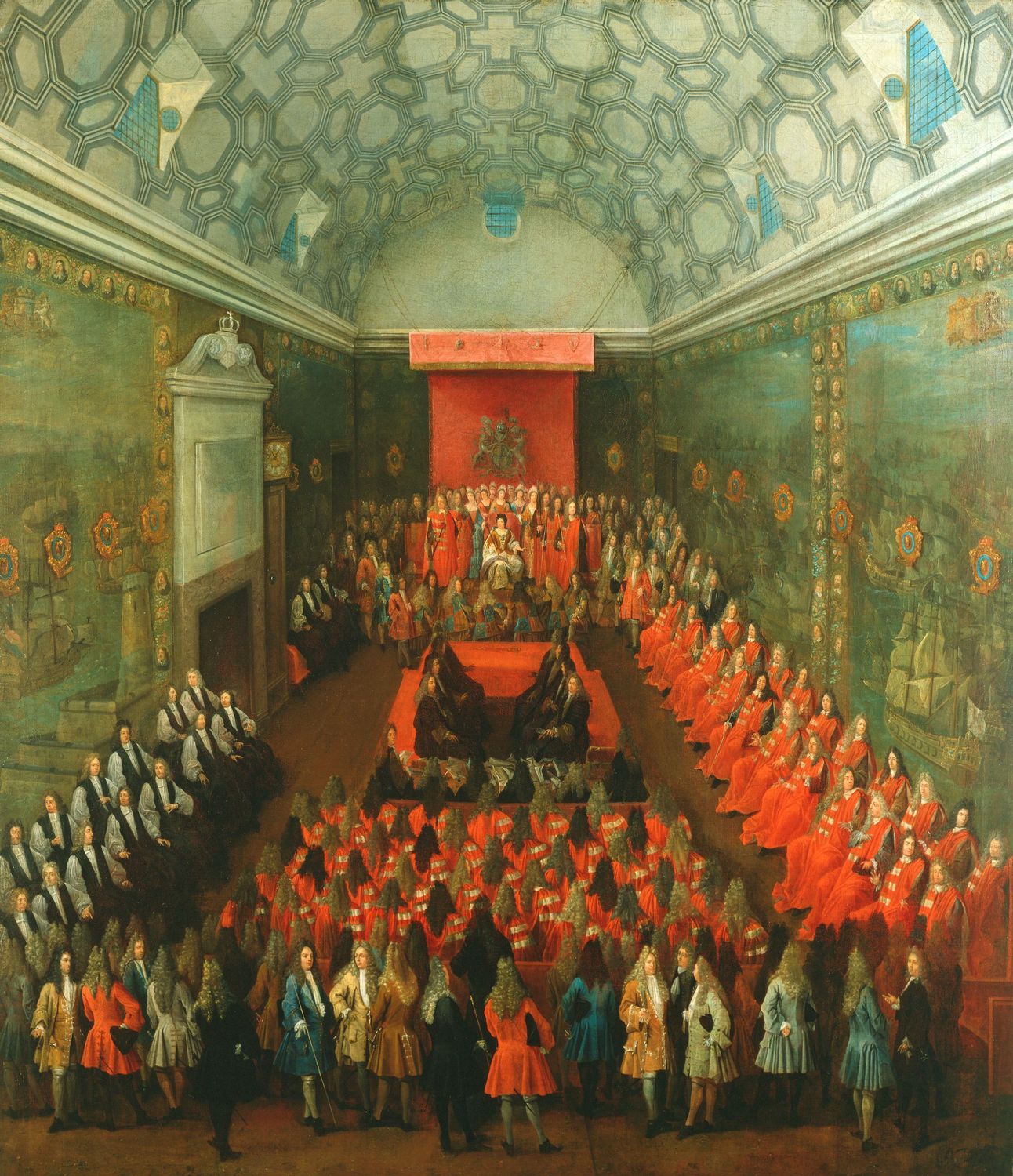
    Queen Anne making laws

    All in all it was a very busy Act of Parliament. And worth reading from time to time in an age when many people think that copyright is a tool to impede learning by preventing writing, withholding access, and inflating prices. Today we benefit from the public domain, and lively and diverse markets for old and new books, plus a public library system (albeit one under stress), and for those who can afford it digital access to writing of all kinds.

    But today’s faultlines are very visible. Instead of printers laboriously setting type, the new publishers are massive and almost instant copying machines, whose advertising engines are making unaccountable and unattributable money from the efforts of writers and creators. This widespread abuse is protected by a kind of enforced pseudonymity, which weakens not only the bonds between identity and authorship, but also our ability to hold each other accountable for our words and actions. And if creativity is flourishing on the horizontal axis, on the vertical, among the undoubted gems there is a viral outbreak of plagiarism and shallow re-use.

    So where the deficit at the start of the 18th century was a self-regenerating engine for learning, at the start of the 21st century we are looking at a deficit of civil discourse and authentic creativity.

    The Lord Keeper of the Great Seal.

    It takes an historical imagination to understand why a late 17th scholar or parliamentarian would think that an Act to create copyright would encourage learning. The argument presented runs thus: Printers had been taking liberties, not asking permission before printing and reprinting, nor sharing the money they were making with writers. The lawmakers wanted to give writers a tool to negotiate a better deal with printers, and redress against infringements of their economic and reputational interests in their writings.

    Alongside the private interests of writers, the public interest was clearly represented in the text and new rights and obligations the Act created. No protection for either the writer’s or the printer’s property could be obtained without a gift to the public of three copies each to the most established libraries of the day. The Act also formalised the public domain, by setting limits on the term of protection. The public interest was further advanced by the establishment of a register of works, under rules which allowed open inspection by anyone who cared to look.

    The Act also added price control; if you thought a book was too expensive you could complain to any of a long list of authorities, including the Lord Keeper of the Great Seal and the Archbishop of Canterbury, who could decide what the fair price should be.

    So, here’s an attempt to frame a Statute for the 21st century. Excuse me while I adjust my wig…

    An Act for the Encouragement of Civil Discourse and Creativity by Vesting the Control of any Representation of Identity; and of the Use or Reuse of any Texts Images Sound Recordings Videos or any other Materials that may be Captured Copied and Transferred on Digital Services and Platforms; in the Person Represented by that Identity, and in the Original Creator of those Materials, during the times therein mentioned.

    Whereas Digital Services and Platforms have of late frequently taken the Liberty of enabling and encouraging the Original Creations of one Person to be copied by another Person without Notice or Permission from the Creator; and in Flagrant Disregard of Common Courtesy allowed one Person to masquerade as Another while denying any Person the Ability to be identified as the Authentic Creator of what they have made; and of allowing and enabling Anonymous Messages to be sent in both Public and Private preventing any Redress for Abuse or Plagiarism of the Counterfeiting of Works of Art and Literature and Music; to the Detriment of Writers, Artists, Musicians, and Others who live by selling Copies of their Creations; and to the Great Detriment of Civil Discourse between People; May it be Enacted that the True Identity of each Person as they are Represented on such Digital Services and Platforms, and the Authentic Origination of any of Such Materials as they Create or Make, and any Permissions and Notifications about uses of Such Materials shall be solely under the Control and Right of those Persons; and further that any Assignment of those Rights and Permissions to the Owners and Operators of Digital Services and Platforms shall be subject to Valuable Consideration and shall be Accurately Recorded, such Records being freely available to any Interested Person on Demand.

    If the sceptics are right we might well be coming to the end of the efficacy of copyright in the encouragement of learning. Times have after all changed, and printing presses are daily becoming less essential to the dissemination of knowledge and the exchange of ideas. But even if they are right, three hundred years is a pretty good run for an idea of how law and markets needed to be shaped, and we can apply the same approach and sound thinking to the deficits we see in today’s lives as they are lived on digital platforms.

    Today we need better ways to talk to each other in public, so that divisions move towards compromise rather than conflict. And we need support for creativity that is less at the whim of the owners of digital platforms, who can tweak whole classes of creators out of a living by tuning an advertising algorithm or changing some monetisation rules; and whose incentives are diametrically opposed to authenticity and originality of content if it gives the creator stronger pricing power. We should recognise a common interest in getting this right for the next three hundred years. Those 17th century printers moaned and whined about the enfranchisement of writers, but profited handsomely from the encouragement of learning that copyright brought.

  • Three Conditions for Independent Music to Survive

    A little over two years ago I set out three reasons why I thought indie music was poised for a period of cultural and commercial success. Those reasons seem still valid now, but a series of events in the indie music world has shown that I overlooked some important factors.

    Floral Matryoshka set

    My biggest mistake was to assume that major labels would not want to buy margin-shrinking and inherently weak independent distribution companies. Since 2015, several ‘insider’ distributors (the kind whose founders and owners sit on trade association boards) have been sold to major labels, or major owned distributors. It’s impossible to understand these acquisitions any way other than by the damage they do to market access for successful small record labels; these deals must be strategic.

    The second mistake I made was in over-optimism that the ‘digital dividend’ would materialise for small businesses. Online platforms have revolutionised how teams can operate around the world, but indie labels seem to have missed out somehow. Perhaps their needs are so specialised that more generic tools – productivity suites, online accounting – just don’t have the same impact as in other industries.

    Time then for a rethink. And it is one from the same fundamental optimism of a few years ago, but with some caution and new caveats. So instead of offering reasons why indie music will thrive, here are three conditions for survival as we head towards the end of Q1 of the 21st century:

    Efficient Collective Rights Management

    The indie music world seems to me to have fully accepted the need for intermediaries, aggregation, and where it’s necessary, collectivisation. What’s more, Merlin has set standards in rights management that have lifted the quality of licensing across the whole market.

    A Thriving Marketplace for Services

    Small businesses buy in more and use in-house teams less. Our community has not generated an effective market in the services we need, from sales and royalty systems to production, design, marketing, business information, and intelligence. Instead we have churn in providers, and risk for investors that customers will disappear at a moment’s notice.

    An Indie Scale Connected Digital Platform

    New music markets need new digital infrastructure to help indie labels manage releases and coordinate their relationships, not just with the music services they supply, but also the other services that they need to buy in. Platforms can transform industries, becoming almost like a computer operating system in the way they connect resources and processes. A platform is what connects the rights, the assets, the businesses and the people together to deliver all the other benefits of the digital world to independent music.

    …And What Won’t Work…

    And it is worth setting out what clearly won’t work, as aggressive major labels and VC funded businesses continue to take bites out of indie music infrastructure and catalogue.

    The first and foremost of our impediments is the attitude that scale doesn’t matter in technology – that somehow a two person startup with a rented database and some code is an adequate answer to the massive platforms we now interact with daily. Our dependence on technology I have heard described, depressingly, as ‘the tail wagging the dog’. This particular tail has been wagging the dog for at least the last 15 years.

    And a new respect for the strategic importance of technology should be accompanied by a scale up mentality in how we nurture service providers, rather than a start-up culture with the inevitable failure rates and, even worse, success through acquisition. All the best new talent is being snapped up by the big music services, leaving us data and capability poor. Better prospects over the longer term for the smartest people will mean that the other great benefits of working with music – the culture, and the community – really do help us stop the brain drain out of the supply side of our industry.

    I remain optimistic that another two years could see us starting to gain traction with a global community of independent music companies and service providers, leading the conversation with the big tech platforms, and setting the terms for our businesses and for music. We just need to straighten up and fly right.